
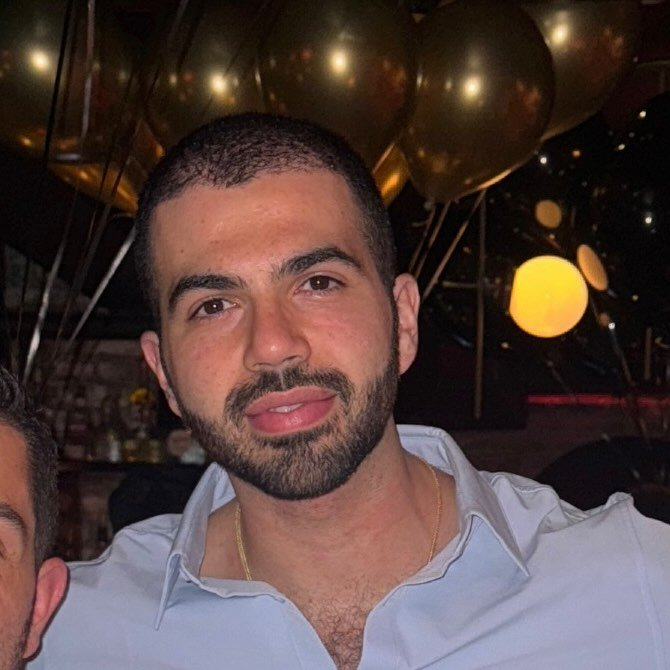
Ten Years of Craft, One Big Shift
Michael Tobi Jewelry started nearly a decade ago, built on family connections in wholesale jewelry and manufacturing. In the past year, Michael went all-in: a dedicated brand specializing in custom and bridal jewelry, where every client works directly with the person building their piece.
"The thing that I always stress to my clients is that when they're working with me, they're working with the person who's building their product from A to Z," Michael says. "Someone that's touching the gold that's going into their ring, touching the diamond that's set on their ring. Having that control over the entire process adds a lot of value."
That manufacturing fluency is his edge — and he's watched it become more important as the whole industry shifts. "The industry has moved a lot more towards custom design relative to off-the-shelf products," he says. "When you have that knowledge of how a piece is built, how it comes together, and everything it takes for a piece to look cohesive and clean and high quality — that's when you're able to sell a product much better."
But knowing how to build anything a client could imagine created a new problem: how do you show them?
The Challenge: You Can't Sell What Clients Can't See
"The number of styles you could potentially consider when creating an engagement ring is an incredible number," Michael says. "I had no way of possibly showing that number of products to a client in person."
In practice, that meant defaulting to classic designs and physical stock — and a lot of legwork whenever a client wanted something specific. Say a client wanted a 14-karat yellow gold solitaire with diamonds on the shank and a hidden halo in a very specific width. By the time Michael tracked down something close — calling around, waiting on samples — the client's enthusiasm had cooled.
The cost? "Time and lost sales."
And there was a ceiling on growth itself. "My entire business for custom and bridal jewelry was essentially 95% from referrals," Michael says. Referrals were working — but a referral-only business only grows as fast as word of mouth travels.
The core problem
The Solution: Put the Design in the Client's Hands
Michael embedded ShowroomPro's AI ring builder on his site — and the dynamic of every sale changed.
"You get that visualization of so many different ideas you could possibly consider for an engagement ring," he says. "It puts the control in the hands of the client to make that decision, rather than in the hands of the person who's selling — who's constricted by however few engagement ring styles they have in their showroom."
That involvement does something a showroom case never could: when clients input their own criteria, they become part of the process. "They're saying, 'We designed this, we really love the look of this — let's recreate it.'" And because clients design on his website, under his brand, the sale stays with him — instead of leaking to a big online retailer.
He didn't wait for traffic to find him
Michael was candid about his one hesitation before signing up: he wasn't sure he had enough of a following. His math was simple: "All I need is a couple of engagement ring sales for this to pay for itself." So he went on offense — working with a marketing agency and the Facebook pixel ShowroomPro installed, he shifted to targeted campaigns built to drive engagement ring buyers straight into the builder. "My idea with the marketing push was to get that in front of as many potential engagement ring buyers as possible — they build their ring, see a visualization of it, and I immediately follow up and try to close the sale."
The Results: Faster Closes, Bigger Market
Five engagement ring sales in his first two months — plus, as Michael puts it, "something like 20 to 25 strong leads that could potentially close, if not now then in the future." In one month alone, his clients created over 130 ring designs.
"By the time they were able to see how the product would look, that's really all they needed to give me a deposit and go ahead with production. They didn't need to think about it any longer."
One referral client came in unsure of what he wanted. Michael pointed him to the ring builder. The client was impressed, and gained clarity from seeing the ring exactly the way he'd imagined it. That visualization was all it took.
"The biggest value is the time you can save when closing an engagement ring sale," Michael adds. "All they need to see is a visualization."
The contrast with traditional retail is stark: "If they're window shopping in a jewelry store and nothing catches their eye, chances are that client walks out and doesn't buy anything."
Growth beyond referrals
"If you're able to get the right buyers to use this tool, you can expand to an entirely new market of potential buyers that you never knew existed" — a real shift for a business that was 95% referral-driven.
Follow-ups that never feel cold
Every lead arrives with the exact ring the client designed. "If I'm able to get someone on the phone, I'll specifically mention something about the ring they designed — so they see this isn't just a generic sales call."
Bottom line
What's Next: Doubling Down
For Michael, the first two months were proof of concept. Now the plan is scale.
He's putting more fuel behind the strategy that's working — targeted campaigns driving engagement ring buyers straight into his ring builder — while working the 20–25 strong leads already in his pipeline.
He's also going deeper into the platform, expanding from the ring builder into ShowroomPro's AI Content Studio to power his social media and marketing imagery — turning the designs his clients create into content that attracts the next wave of buyers.
"If you're creating good product and a good customer experience, that client is going to refer me to another client, and the chain just keeps building. And the aggressive push behind a tool that helps a buyer close much quicker is also a very powerful thing. The two together is a recipe for success for a small jewelry business."